By Dr. Dixit Kumar Thakur
Every week at Pulmovista Clinics, I see the same pattern. A patient walks in — breathless, exhausted, rescue inhaler in hand — telling me they’ve been ‘managing’ their asthma the same way for years. A Salbutamol puff when symptoms hit. Maybe a steroid inhaler used irregularly. And a life quietly shaped around what their lungs will and won’t allow.
This approach — what most people still think of as standard asthma treatment — is now outdated. The Global Initiative for Asthma (GINA) updated its guidelines significantly, and the 2026 recommendations make one thing crystal clear: SMART therapy is now the preferred treatment strategy for the majority of asthma patients, replacing the traditional model of a separate rescue inhaler and controller inhaler.
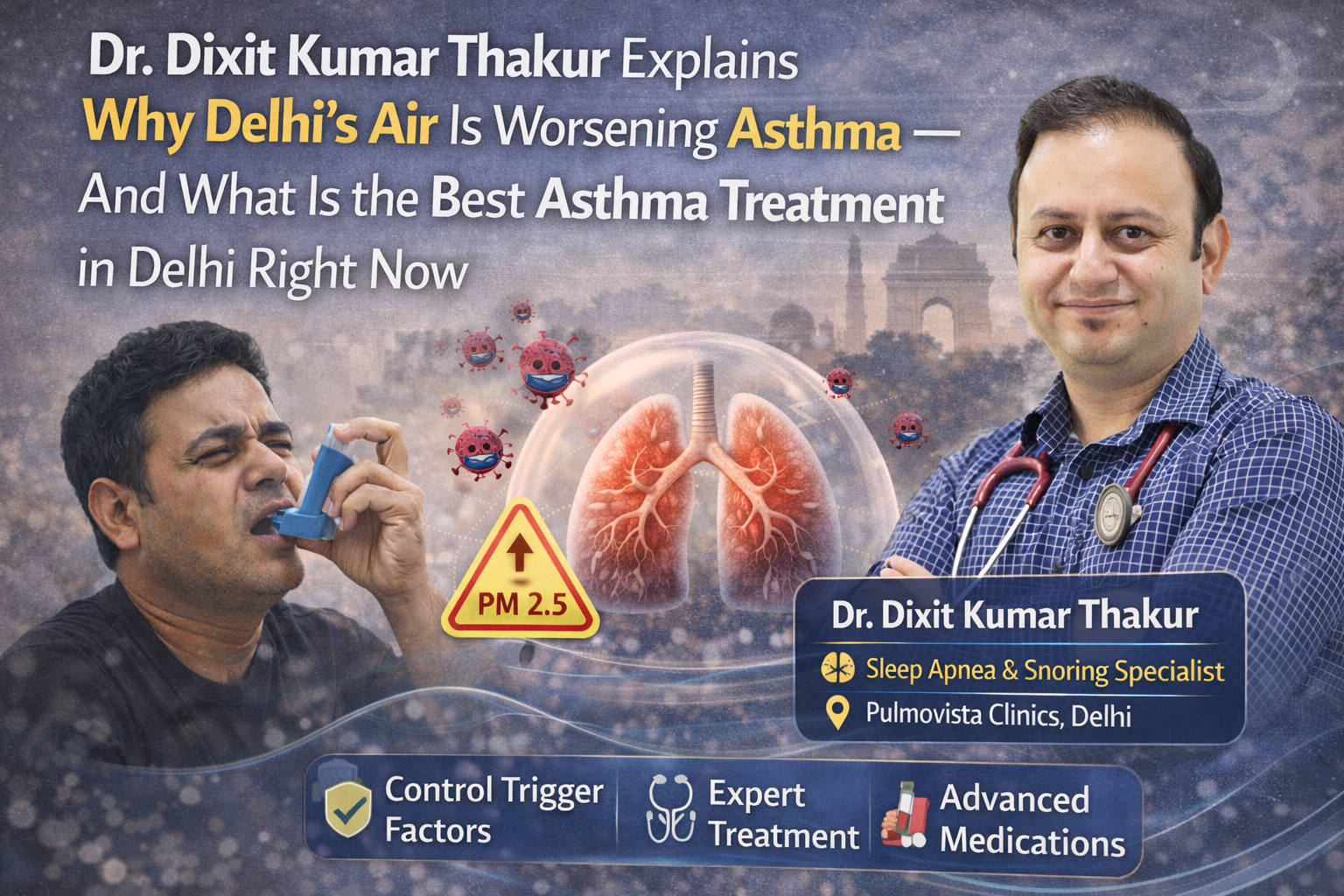
In Delhi — where PM2.5 pollution, year-round allergens, seasonal stubble burning, and unpredictable weather create one of the most challenging asthma environments in the world — the difference between SMART therapy and traditional inhaler use is not just academic. It can mean the difference between controlled asthma and a life-threatening exacerbation.
In this guide, I will explain exactly what SMART therapy is, how it compares to traditional inhalers, why it matters specifically for asthma patients in Delhi, and what the best asthma treatment in Delhi looks like in 2026.
1. What Is Traditional Inhaler Therapy — And Why It Is No Longer Enough
For decades, the standard approach to asthma treatment followed a simple two-inhaler model. Patients were given a blue SABA rescue inhaler (such as Salbutamol) to use when symptoms occurred, and a separate daily controller inhaler containing an inhaled corticosteroid (ICS) to reduce baseline airway inflammation.
| Inhaler Type | Role in Traditional Therapy |
| SABA (Short-Acting Beta-Agonist) | Rescue inhaler — used when symptoms occur (e.g. Salbutamol / Ventolin) |
| ICS (Inhaled Corticosteroid) | Daily controller — reduces inflammation (e.g. Budesonide, Fluticasone) |
| ICS + LABA Combination | Step-up controller for moderate-severe asthma (e.g. Seretide, Symbicort) |
On paper, this model works. In practice — particularly in a high-pollution city like Delhi — it fails many patients for critical reasons:
The Core Problem: SABA-Only Reliance
The majority of asthma patients worldwide rely almost exclusively on their blue SABA rescue inhaler and use their controller inhaler irregularly — or stop it entirely when symptoms improve. This creates a dangerous and self-reinforcing cycle:
• Symptoms improve temporarily after a SABA puff → patient assumes asthma is under control
• Underlying airway inflammation continues undetected → airways become progressively more sensitive
• Next pollution spike or allergen exposure triggers a much worse attack
• Patient uses SABA again for temporary relief → cycle repeats, each time leaving slightly more airway damage
GINA now explicitly states that SABA-only therapy — even for mild asthma — is no longer recommended. Every SABA-only rescue event, without accompanying anti-inflammatory treatment, is a missed opportunity to treat the underlying disease and prevent long-term airway remodelling.
Why Delhi Makes Traditional Therapy Even Less Effective
• PM2.5-driven airway inflammation (neutrophilic type) is partially resistant to standard inhaled corticosteroids — meaning your ICS controller may be doing less than you think.
• The frequency and unpredictability of Delhi’s pollution spikes means patients need flexible, dynamic therapy — not a fixed daily dose with a separate rescue option.
• High allergen burden (dust mites, moulds, pollens, cockroach) on top of pollution overloads the anti-inflammatory capacity of standard low-to-medium dose ICS therapy.
• Delhi’s extreme temperature swings — between winter nights and afternoons, and between air-conditioned interiors and outdoor heat — constantly challenge airway stability in ways traditional fixed therapy cannot adapt to in real time.
2. What Is SMART Therapy? A Plain-Language Explanation
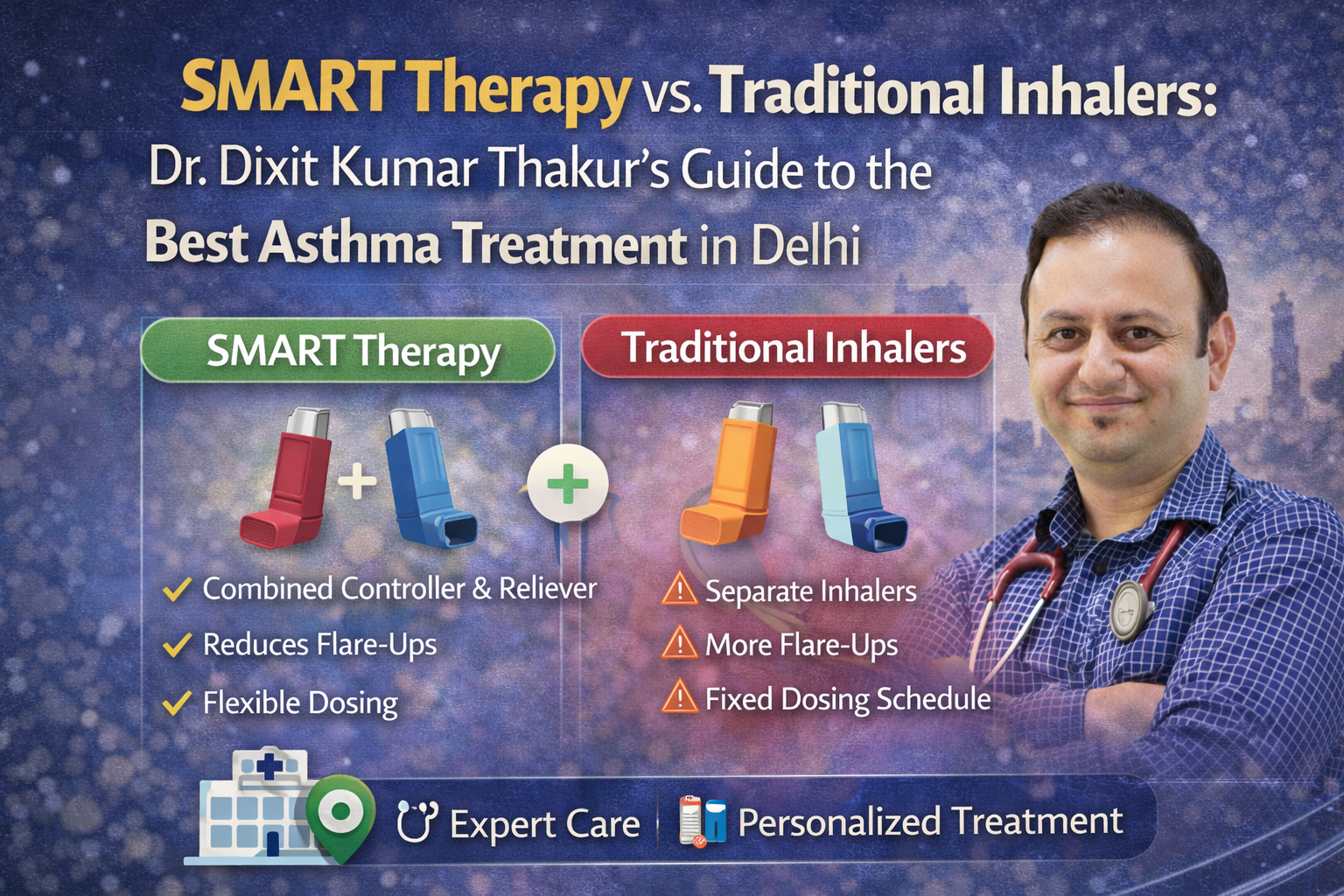
SMART stands for Single Maintenance And Reliever Therapy. It is an approach in which a single combination inhaler — containing both an inhaled corticosteroid (ICS) and a fast-acting formoterol (a type of LABA) — is used for BOTH daily maintenance AND as-needed relief.
The key insight is elegantly simple: every time your asthma worsens and you reach for a rescue puff, you also need more anti-inflammatory treatment. SMART delivers both simultaneously, in the same device, with every single puff.
| ✔ How SMART Therapy Works — The Core Principle ✔ One inhaler performs two jobs: daily controller AND as-needed rescuer ✔ Every rescue puff automatically delivers an anti-inflammatory ICS dose ✔ Eliminates the ‘treat symptoms, ignore inflammation’ gap of traditional therapy ✔ Proven to reduce severe exacerbations by up to 45–64% vs. traditional SABA rescue ✔ Endorsed as preferred therapy by GINA 2024, 2025, and 2026 guidelines ✔ Especially powerful in Delhi’s variable, high-pollution environment |
Which Inhalers Are Used in SMART Therapy?
SMART therapy requires a combination inhaler where the LABA component (formoterol) acts quickly enough to provide rescue relief as well as sustained daily maintenance. Not all combination inhalers qualify. The following are SMART-compatible devices approved for use in India:
| SMART-Compatible Inhaler | Components & Notes |
| Symbicort Turbuhaler | Budesonide + Formoterol — most widely prescribed SMART inhaler; DPI format |
| Duoresp Spiromax | Budesonide + Formoterol — breath-actuated DPI; ideal for poor coordination |
| Fosterair / Vannair | Beclomethasone + Formoterol — extra-fine particle; excellent lung deposition |
| Bufomix Easyhaler | Budesonide + Formoterol — good for elderly patients and children ≥6 years |
| ⚠ Critical: Not All Combination Inhalers Can Be Used as SMART Only formoterol-containing combination inhalers qualify for SMART therapy. Seretide (Fluticasone + Salmeterol) and similar salmeterol-based inhalers are MAINTENANCE ONLY — never use as rescue inhalers. Salmeterol is slow-acting and cannot provide emergency bronchodilation. Using the wrong inhaler as a rescue can delay appropriate treatment and worsen an attack. Always confirm your SMART therapy regimen with Dr. Dixit Kumar Thakur at Pulmovista Clinics. |
3. SMART Therapy vs. Traditional Inhalers: A Full Comparison
The table below gives a direct, comprehensive comparison across every dimension that matters to asthma patients seeking the best asthma treatment in Delhi:
| Factor | Traditional Therapy | SMART Therapy (GINA 2026) |
| No. of inhalers needed | 2 — separate rescue + controller | 1 — single inhaler does both |
| Rescue medication | SABA only (e.g. Salbutamol) | ICS + Formoterol — anti-inflammatory + bronchodilator |
| Anti-inflammatory on rescue | None — SABA has zero anti-inflammatory action | Yes — every rescue puff delivers ICS |
| Adapts to symptom burden | No — fixed daily dose regardless | Yes — dose adjusts naturally with symptom frequency |
| Severe exacerbation reduction | Standard baseline | Up to 45–64% reduction vs. SABA rescue |
| Oral steroid courses needed | More frequent | Up to 50% fewer courses needed |
| Real-world adherence | Poor — patients skip controller | Better — one inhaler is simpler to remember and use |
| GINA 2026 status | No longer preferred — SABA-only strongly discouraged | Preferred strategy — Steps 1 through 4 |
| Delhi pollution suitability | Limited — misses pollution spike days | High — extra rescue puffs provide extra ICS automatically |
| Cost efficiency | Two inhalers, two prescriptions | One inhaler — often more cost-effective overall |
| “When I switched my patients at Pulmovista from traditional SABA rescue to SMART therapy, the results were remarkable — fewer emergency visits, fewer oral steroid courses, and most importantly, patients telling me for the first time that they feel genuinely in control of their asthma.” — Dr. Dixit Kumar Thakur, Pulmovista Clinics, Delhi |
4. GINA 2026: What the Latest Global Guidelines Say
The Global Initiative for Asthma (GINA) is the world’s most authoritative body on asthma management. Its 2026 guidelines represent the current gold standard for asthma treatment globally. At Pulmovista Clinics, Dr. Dixit Kumar Thakur ensures every patient’s treatment plan is fully GINA 2026 compliant — something that cannot be said of all general practice settings in Delhi.
6 Key GINA 2026 Updates Every Delhi Asthma Patient Must Know
1. SABA-only therapy is now explicitly not recommended at any step — including mild intermittent asthma. If you are still on ‘only use your blue inhaler when you need it,’ your treatment is outdated and potentially dangerous.
2. As-needed low-dose ICS-formoterol is now first-line for Step 1 (mild intermittent) asthma. Even patients with infrequent symptoms should use an ICS-formoterol combination as rescue — not a plain SABA.
3. SMART therapy is the preferred strategy from Step 2 upwards, covering the vast majority of persistent asthma patients — mild through severe.
4. Phenotype-guided treatment is now mandatory for all patients not responding adequately to Step 3–4 therapy. FeNO testing, blood eosinophil counts, and allergy profiling must be performed before escalating — not after.
5. Biologic therapies are positioned at Step 5 for severe uncontrolled asthma, with updated GINA 2026 biomarker thresholds guiding biologic selection with greater precision than ever before.
6. Environmental co-exposure management is now a formal part of the GINA framework — air quality interventions (N95 masks, HEPA air purifiers, trigger avoidance) are clinical recommendations, not optional lifestyle advice. This is particularly critical for Delhi.
| ✔ Pulmovista Clinics: Fully GINA 2026 Compliant ✔ All prescriptions reviewed against the GINA 2026 treatment algorithm ✔ No patient is left on SABA-only therapy — all receive appropriate ICS-formoterol ✔ Spirometry and FeNO used to guide every step-up and step-down decision ✔ Biologic therapy assessment available on-site for Step 5 patients ✔ Written personalised asthma action plan provided to every patient at Pulmovista ✔ Delhi-specific pollution and environmental control advice integrated into every consultation |
5. Who Should Switch to SMART Therapy?
Based on GINA 2026 and over 13 years of clinical experience treating asthma patients in Delhi, Dr. Dixit Kumar Thakur at Pulmovista Clinics recommends SMART therapy for the following patient profiles:
Ideal Candidates for SMART Therapy
• Patients currently on SABA-only therapy — this is the most urgent group to switch. Salbutamol alone is no longer an acceptable asthma treatment strategy at any severity level.
• Patients using rescue inhaler more than twice per week — a clear clinical signal of uncontrolled asthma requiring step-up to SMART.
• Patients who frequently forget or skip their controller inhaler — one-inhaler SMART simplicity dramatically improves real-world adherence.
• Patients with pollution-sensitive asthma in Delhi — SMART provides automatic extra anti-inflammatory cover on high-AQI days through as-needed use.
• Patients with exercise-induced bronchoconstriction — as-needed ICS-formoterol before exercise provides both bronchodilation and anti-inflammatory protection simultaneously.
• Patients with seasonal worsening (October–February in Delhi) — SMART’s flexible dosing naturally compensates for increased trigger burden during Delhi’s worst pollution months.
Patients Who May Need More Than SMART Therapy
• Severe, refractory asthma patients (GINA Step 5) who continue to exacerbate despite high-dose ICS-formoterol SMART — biologic therapy assessment is the next step at Pulmovista.
• Patients with significant comorbidities (severe allergic rhinitis, GERD, obstructive sleep apnoea) — the comorbidity must be diagnosed and treated alongside SMART for full benefit.
• Patients with neutrophilic asthma driven primarily by pollution — may need additional therapies such as azithromycin or leukotriene receptor antagonists alongside SMART.
| 💡 Dr. Dixit Kumar Thakur’s Clinical Note on SMART Therapy in Delhi “The most common mistake I see is patients capping their rescue puffs out of fear of ‘overusing’ the inhaler. The safety and efficacy of SMART depends on patients understanding that rescue puffs are there to be used when needed. The ICS component is what makes SMART safe to use flexibly — unlike pure SABA, which has no anti-inflammatory action and whose overuse is a warning sign, not a treatment. I spend significant time educating every Pulmovista patient on this critical distinction.” — Dr. Dixit Kumar Thakur, Senior Pulmonologist, Pulmovista Clinics, Delhi |
6. Step-by-Step: How to Use Your SMART Inhaler Correctly
Incorrect inhaler technique is one of the most common — and most preventable — causes of poor asthma control. Studies consistently show that over 70% of patients use their inhalers incorrectly, dramatically reducing drug delivery to the lungs. At Pulmovista Clinics, every patient receives a personalised inhaler technique assessment and hands-on training session with Dr. Dixit Kumar Thakur.
For Dry Powder Inhalers (DPIs) — e.g. Symbicort Turbuhaler
1. Hold upright. Never shake a DPI. Unlike MDIs, shaking disperses the powder incorrectly.
2. Twist to load. Rotate the coloured grip clockwise then fully back until you hear a click — one dose is now loaded.
3. Exhale gently — away from the device. Never breathe out into the DPI; moisture from your breath damages the powder dose.
4. Seal lips firmly and inhale FAST and DEEP. DPIs require a strong, fast inspiratory flow to properly disperse the powder into the lungs.
5. Hold breath for 10 seconds, then breathe out slowly through your nose.
6. Rinse mouth with water and spit after every maintenance dose — this prevents oral thrush (candidiasis), a common ICS side effect.
For Pressurised MDIs with Spacer — e.g. Fosterair / Vannair
1. Shake the inhaler vigorously for 5 seconds before each use.
2. Attach a spacer. Always use a spacer with an MDI — without one, up to 80% of the dose hits the throat instead of the lungs.
3. Exhale gently to empty your lungs before inhaling.
4. Press once and inhale SLOWLY and STEADILY for 3–5 seconds. MDIs require slow inhalation — the opposite of DPIs.
5. Hold breath for 10 seconds, then exhale slowly.
6. Wait 30–60 seconds between puffs if a second dose is required.
| ⚠ Common Inhaler Mistakes That Reduce Effectiveness Breathing out into a DPI before inhaling — moisture ruins the loaded powder dose Inhaling too slowly with a DPI — insufficient flow means powder is never properly dispersed Using an MDI without a spacer — the majority of medication is wasted on the back of the throat Not rinsing mouth after ICS doses — increases risk of oral thrush and hoarseness Stopping the controller component when symptoms improve — airway inflammation continues silently even on symptom-free days Storing inhalers in hot or humid places — heat and moisture degrade both powder and propellant formulations |
7. SMART Therapy and Delhi’s Pollution: A Powerful Combination
One of the most underappreciated advantages of SMART therapy is its dynamic responsiveness to the real-time asthma burden — a feature that is uniquely valuable in Delhi’s highly variable pollution environment where AQI can shift dramatically from one day to the next.
| 📋 A Typical Delhi Winter Week: Traditional Therapy vs. SMART Therapy Monday — AQI 180 (Moderate): Patient feels fine. Both approaches perform similarly. Wednesday — AQI 350 (Very Poor): Stubble burning smoke arrives. Traditional patient uses Salbutamol 3× (zero anti-inflammatory effect — inflammation builds unchecked). SMART patient uses 3 rescue puffs — each delivering ICS + formoterol, actively dampening the inflammatory response triggered by PM2.5. Thursday night: Traditional patient wakes at 2am severely breathless — uncontrolled inflammation has reached critical threshold. SMART patient takes 1–2 rescue puffs and returns to sleep — airway inflammation was being treated since Wednesday. Friday: Traditional patient visits Emergency Department. SMART patient calls Pulmovista Clinics for a routine review appointment. |
This scenario reflects the real clinical outcomes documented in landmark SMART therapy trials — including the SYGMA 1 and SYGMA 2 studies — which demonstrated that as-needed ICS-formoterol reduced severe exacerbations by 64% compared to as-needed SABA alone, and by 30% compared to daily ICS plus as-needed SABA.
Dr. Dixit Kumar Thakur’s Pollution-Specific SMART Recommendations for Delhi Patients
• Monitor AQI every morning using the Safar-Air or CPCB app before leaving home — plan your day and your SMART use accordingly.
• On AQI above 200 (Very Poor): take your scheduled maintenance dose as normal and be prepared to use extra rescue puffs proactively at the first sign of airway tightening.
• On AQI above 300 (Severe/Hazardous): wear an N95 mask outdoors, avoid peak pollution hours (8–10am and 6–9pm), and consider staying indoors.
• If you use more than 8 total puffs in a single day: contact Pulmovista Clinics for an urgent review — this level of rescue use signals a significant exacerbation requiring professional assessment.
• Never exceed your personalised maximum daily puff limit — Dr. Dixit Kumar Thakur sets individual limits for every Pulmovista patient on SMART therapy based on their inhaler strength and clinical profile.
8. Advanced Treatments Beyond SMART: What Pulmovista Clinics Offers
For patients whose asthma remains uncontrolled despite optimal SMART therapy, Pulmovista Clinics offers the full spectrum of advanced asthma treatments under the expert care of Dr. Dixit Kumar Thakur — one of Delhi’s leading specialists in severe and difficult-to-treat asthma.
GINA Step 4 Add-On Therapies
• Tiotropium (Spiriva Respimat): A long-acting muscarinic antagonist (LAMA) added to ICS-LABA for adults with persistent symptoms at Step 4 — approved as add-on asthma therapy and proven to reduce exacerbations further.
• Leukotriene Receptor Antagonists (Montelukast): Useful add-on for patients with comorbid allergic rhinitis or aspirin-exacerbated respiratory disease — both common in Delhi allergy patients.
• Azithromycin (low-dose, long-term): For neutrophilic asthma phenotypes — particularly relevant for pollution-driven asthma common in Delhi — reduces exacerbation frequency with an anti-inflammatory macrolide effect.
Biologic Therapies at Pulmovista (GINA Step 5)
| Biologic Agent | Target Patient Profile |
| Omalizumab (Xolair) | Allergic asthma with elevated IgE — most common in Delhi allergy-driven asthma |
| Mepolizumab (Nucala) | Severe eosinophilic asthma — reduces exacerbations by 50%+ |
| Benralizumab (Fasenra) | Severe eosinophilic asthma — rapid eosinophil depletion, 8-weekly maintenance dosing |
| Dupilumab (Dupixent) | Type 2 asthma + atopic dermatitis or chronic rhinosinusitis with nasal polyps |
| Tezepelumab (Tezspire) | Broad severe asthma — effective across all phenotypes including low eosinophil count |
9. Your First Asthma Consultation at Pulmovista Clinics: What to Expect
Many patients tell us at Pulmovista that they have never had a thorough asthma assessment before — they were simply handed an inhaler prescription by a general physician. Dr. Dixit Kumar Thakur takes a fundamentally different approach. Here is what a comprehensive new patient asthma consultation at Pulmovista Clinics involves:
1. Detailed clinical history: Symptom pattern, trigger profile, exacerbation history, medication history, occupational and domestic exposures, and family history of atopy.
2. Inhaler technique assessment: Every patient demonstrates their current inhaler use — errors are identified and corrected immediately with hands-on training.
3. Spirometry with bronchodilator reversibility: Objective measurement of lung function — the diagnostic gold standard for confirming asthma and assessing current severity.
4. FeNO (Fractional Exhaled Nitric Oxide) testing: A 10-second breath test quantifying eosinophilic airway inflammation — essential for ICS dose selection and biologic candidacy assessment.
5. Allergy evaluation: Skin prick testing or specific IgE blood panel for the most common Delhi allergens — house dust mites, cockroach, Aspergillus mould, tree pollens, and grass pollens.
6. Comorbidity screening: Assessment for allergic rhinitis, GERD, obstructive sleep apnoea, and depression/anxiety — all of which independently worsen asthma control.
7. GINA step classification: Formal assessment of asthma severity and control level to determine correct treatment step.
8. Personalised treatment plan: Written prescription including SMART therapy (where indicated), add-on medications, and biologic therapy referral if appropriate.
9. Written Asthma Action Plan: A clear, personalised document telling you exactly what to do when symptoms worsen — when to increase medication, when to seek urgent care, and emergency contacts.
10. Structured follow-up: Typically 4–8 weeks after new therapy initiation, then every 3 months for stable patients — with open-access urgent slots for patients with deteriorating control.
Conclusion: The Best Asthma Treatment in Delhi Starts With the Right Strategy
The shift from traditional inhaler therapy to SMART therapy is not a minor update — it is a fundamental rethinking of how asthma should be managed. This shift is especially important in Delhi, where pollution burden, allergen exposure, and seasonal triggers constantly challenge the limits of fixed, symptom-agnostic dosing regimens.
GINA 2026 is unambiguous: SABA-only rescue is outdated and potentially dangerous. SMART therapy — ICS-formoterol as both maintenance and reliever — is the evidence-based standard of care for the vast majority of asthma patients today. At Pulmovista Clinics, Dr. Dixit Kumar Thakur has helped hundreds of Delhi patients make this transition — moving from reactive, symptom-chasing inhaler use to a proactive, GINA-compliant strategy that genuinely controls asthma rather than merely masking it.
If you are still relying on a blue Salbutamol inhaler as your primary asthma management tool — or if your asthma feels less controlled than it should — it is time for a specialist review. The best asthma treatment in Delhi is not more puffs of the same outdated inhaler. It is the right therapy, correctly prescribed, by a pulmonologist who understands your lungs, your lifestyle, and the air you breathe every day in this city.
FAQs-SMART Therapy and Best Asthma Treatment in Delhi
- Is SMART therapy safe for long-term use?Yes. SMART therapy has an excellent long-term safety profile supported by over a decade of clinical trial data involving hundreds of thousands of patients worldwide. The ICS doses used are the same as those in traditional controller therapy — delivered more intelligently, precisely when and where they are needed. Dr. Dixit Kumar Thakur monitors all Pulmovista patients on SMART therapy with regular spirometry and clinical review to ensure optimal dosing over time.
- Can children use SMART therapy for asthma in Delhi?SMART therapy with budesonide-formoterol is approved for children aged 6 years and above. For younger children, age-appropriate ICS therapy with spacer devices is used. Dr. Dixit Kumar Thakur has extensive experience in paediatric asthma at Pulmovista Clinics and tailors treatment to the child's age, weight, device capability, and Delhi-specific trigger profile.
- How quickly does SMART therapy show results?Most patients notice meaningful improvement in symptom control within 2–4 weeks of switching to SMART therapy. Objective improvement in spirometry (FEV₁) is typically measurable at the 4–8 week follow-up. Reduction in exacerbation frequency becomes evident over the first 3–6 months. Patients previously on SABA-only therapy often notice the most dramatic and rapid improvement.
- Does SMART therapy replace biologic injections?For the majority of asthma patients — mild through moderate-severe — SMART therapy provides excellent control and no biologic is required. Biologic therapy is reserved for truly severe, uncontrolled asthma (GINA Step 5) that continues despite optimal SMART. At Pulmovista Clinics, Dr. Dixit Kumar Thakur conducts a structured biomarker evaluation to determine biologic candidacy.
- How do I book a consultation with Dr. Dixit Kumar Thakur at Pulmovista Clinics Delhi?You can book an asthma consultation with Dr. Dixit Kumar Thakur at Pulmovista Clinics by visiting www.pulmovista.com or calling the clinic directly. Both in-person and teleconsultation appointments are available across Delhi NCR. Urgent review slots are reserved for patients with deteriorating control — please mention this when booking.